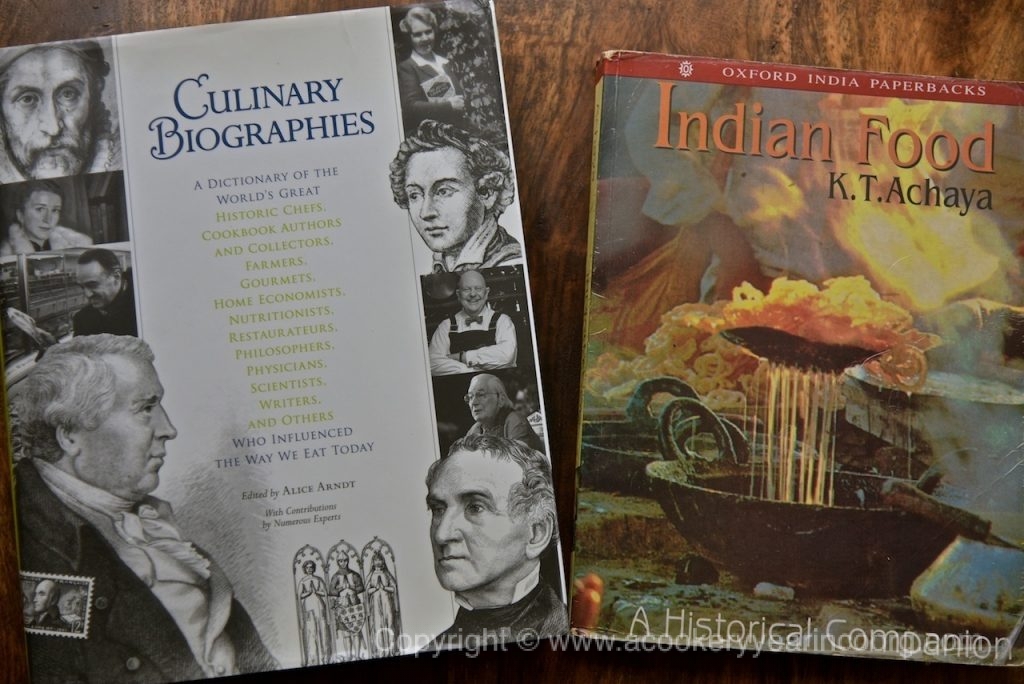
The article featured here appears in Culinary Biographies: A Dictionary of the World’s Great Historic Chefs, Cookbook Authors and Collectors, Farmers, Gourmets, Home Economists, Nutritionists, Restaurateurs, Physicians, Scientists, Writers, and Others Who Influenced the Way We Eat Today. Edited by Alice Arndt. (Yes Press, Houston)
Of particular interest to me in this fascinating book, is a biography of Dr K.T. Achaya, scientist and culinary historian who hailed from Coorg. This entry was authored by Bob Lucky with Vinod Huria.
In the interests of sharing this biography with a wider readership, I have permission from Robert Arndt to reproduce the piece on K.T. Achaya from Culinary Biographies. My grateful thanks to him.
(This material is copyright of Alice Arndt. Do not reproduce it in any form without consent from the author’s estate!)
K.T.Achaya 1923-2003
Also Called: Dr. Konganda Thammu Achaya | Doc
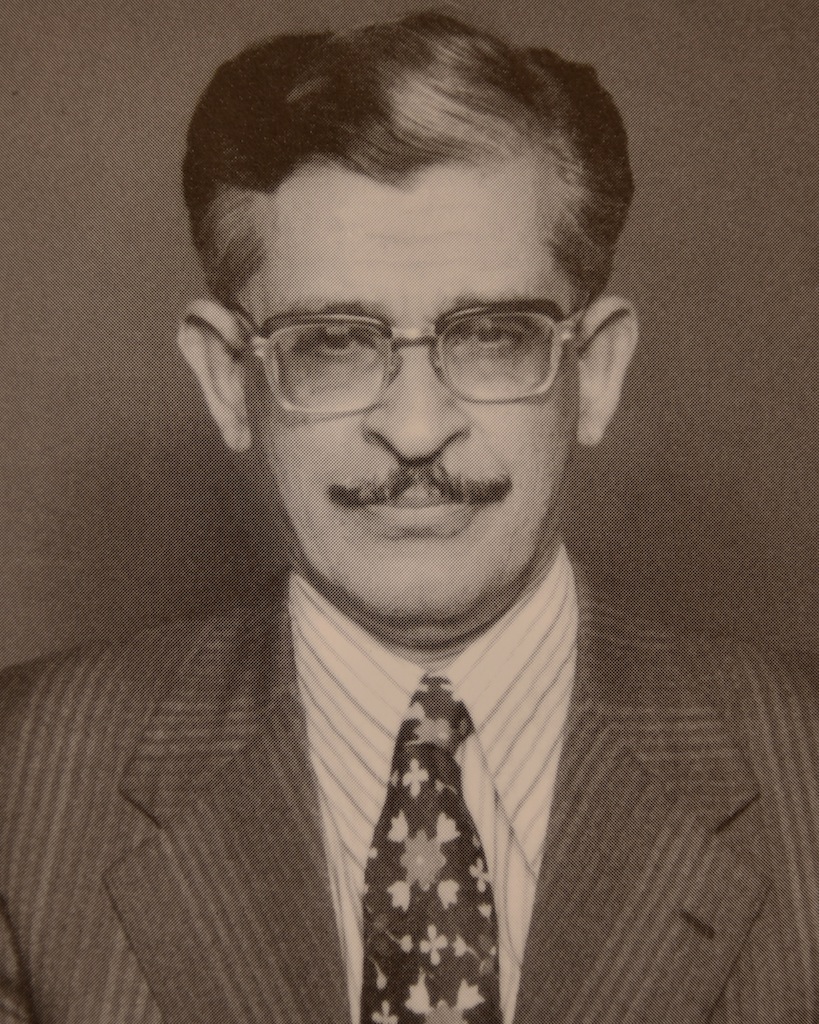
K. T. ACHAYA, THE INDIAN CHEMIST AND FOOD HISTORIAN known as “Doc” to his many friends and colleagues, was a lifelong bachelor who half-jokingly referred to himself as a “cowboy” because he had worked so long in the chemistry of dairy products and milk production. His research later turned to oils and oil production, nutrition, and food technology. It was after his retirement that he ventured into the world of food history. “I had all these notes, and all this time,” he explained, and he made excellent use of both.
The book that made serious Western historians of food take note was Indian Food: A Historical Companion (1994). Here, at last, was a book on Indian food that went beyond curry, that didn’t treat the cuisines of India as something beginning and ending with the British Raj. It had scope-the opening sentence begins, “Three hundred million years ago…and depth. There are footnoted references, glossaries, and several indices. A lifetime of research and intellectual curiosity led to that book, and it is a book that could well lead someone into a lifetime of research on the subject.
Born into a large family on October 6, 1923 at Kollegal (then in Madras Province, but now in Karnataka), Achaya graduated from Madras University with chemistry honors in 1943. He also received his MSc from that university while working at the Indian Institute of Science in Bangalore. He received a government scholarship for his doctoral studies, and sailed for England to work at the University of Liverpool, where he focused on the chemistry of cow and buffalo ghee. His research found a place in the Proceedings of the Royal Society.
It was at that time that he published his first book, Indian Dairy Products (1948), co-authored with K. S.Rangappa. A revised edition was published in 1974, and it is still considered one of the most important books in the field.
In 1949, Achaya returned to India and was picked in 1950 to help establish what was later named the Regional Research Laboratory (RRL), an institute under the auspices of the Indian Council of Scientific and Industrial Research (CSIR). (RRL is now the Indian Institute of Chemical Technology.) During his 22-year tenure there, the institute garnered international recognition and was awarded several patents, and Achaya published another groundbreaking work, Cottonseed Chemistry and Technology, co-authored with K. S. Murti. During this period, Achaya went abroad twice, once to work on biological lipids at the University of Southern California, Los Angeles, and later to a laboratory of the National Research Council in Saskatoon, Canada, where he unraveled the glycerides of castor oil.
In 1971, Achaya became the executive director of the Protein Foods and Nutrition Development Association of India in Mumbai (Bombay), where one of his goals was to develop and distribute inexpensive, nutritious, ready-to-eat meals to the poor. Although a few products were test-marketed, the project never got off the ground. However, his book on nutrition, Your Food and You, became popular
and was translated into several Indian languages.
Achaya next moved to Mysore to be closer to his home, Coorg, in Karnataka, where he became a consultant to the United Nations University Programme at the Central Food Technological Research Institute in 1977, a program designed to train people from developing countries in food science and technology. He retired in 1983 and published Everyday Indian Processed Foods the following year.
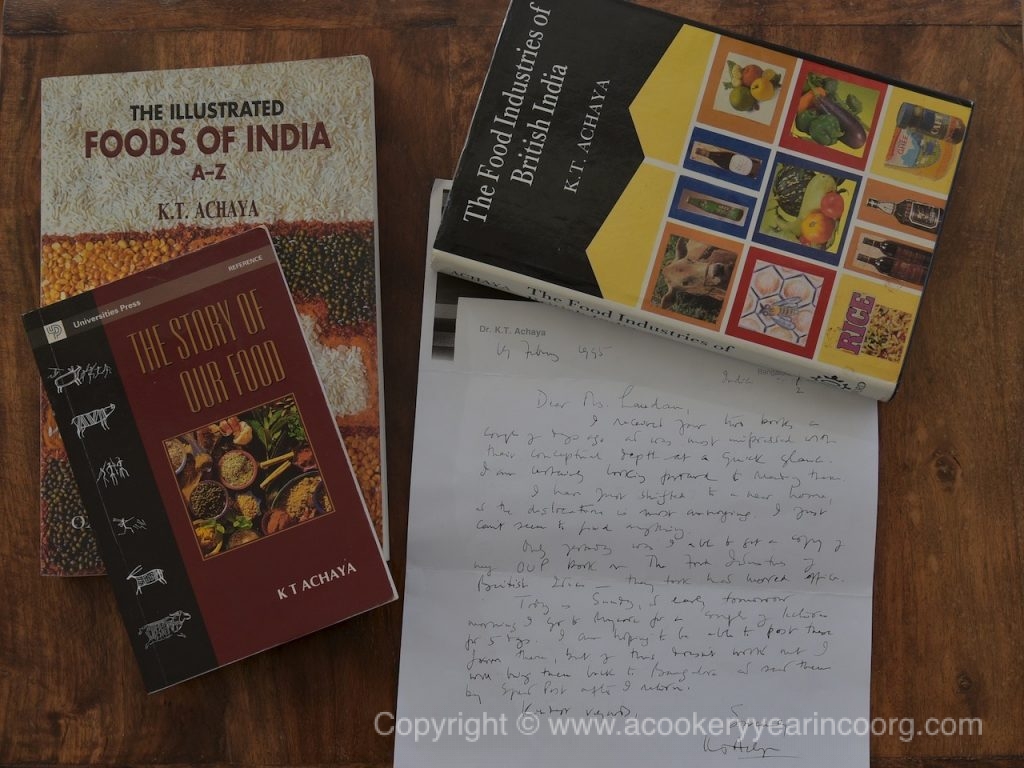
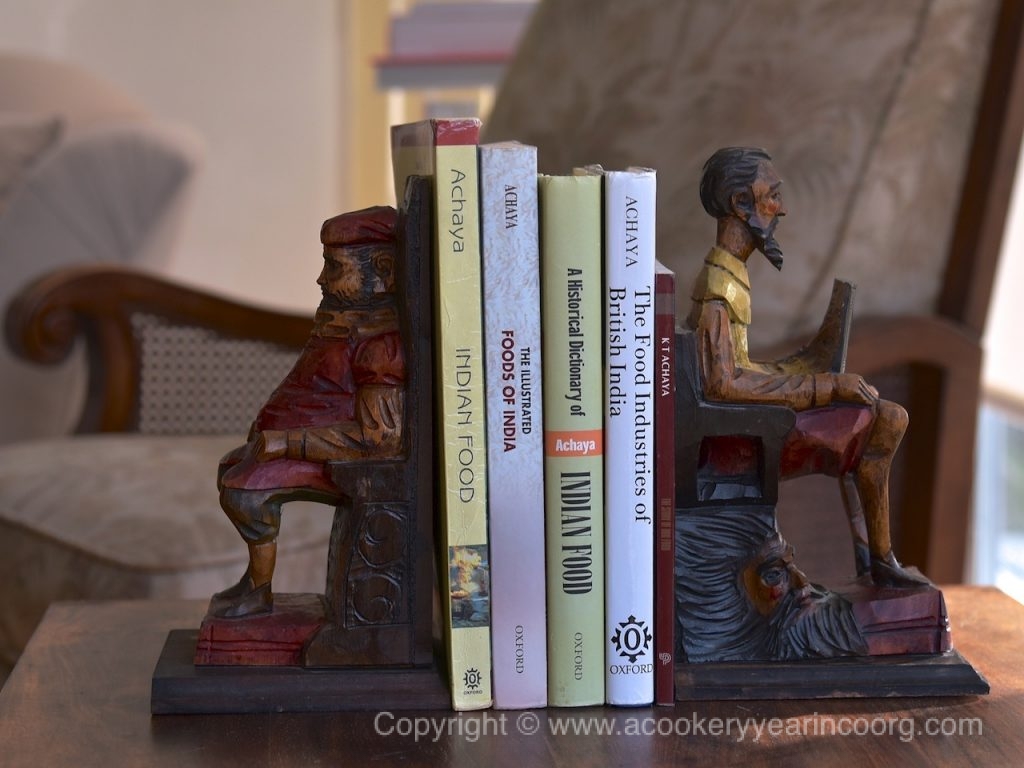
His retirement was productive. In addition to Indian Food: A Historical Companion, he published Oilseeds and Oil Milling in India: A Cultural and Historical Survey (1990), Ghani: The Traditional Oil Mill of India (1993), The Food Industries of British India (1994), A Historical Dictionary of Indian Food (1998), and The Story of Our Food (2000). When I visited him in Bangalore in March 2002, he had recently completed four articles on Indian food for an Italian encyclopedia, and claimed it was his last writing – though in conversation with my wife, he revealed a desire to write something about Indian classical music, a passion of his.
Achaya had many such extracurricular interests, among them photography, art,
cinema, books, sports, and food, in addition to both Indian and Western classic music. Six months before his death, an article in The Hindu (February 25, 2001) had hailed him as “the Leonardo of Bangalore.” I believe that the comparison with da Vinci embarrassed him, but however modest he was, there is no denying that when Achaya passed away on September 5, 2002 there was one fewer Renaissance man in the world.
Every student of food and foodways in South Asia will be forever indebted to him.
BOB LUCKY with VINOD HURIA
The late Alice Arndt was a culinary historian and author. She identified a need to compile, in the form of a biographical dictionary, information about influential figures from across the spectrum of the arts and sciences – from entrepreneurs to farmers and inventors – all of whom had an impact on the way we eat today.
It was a timely enterprise, given the burgeoning interest in all aspects of food, including how and what we eat.
Over seven years in the making, Culinary Biographies, published in 2006, is a truly absorbing journey across continents, centuries, and personalities , some familiar, others unsung, or lost in time, and yet others, like Betty Crocker, figments of a corporate imagination!
As reviewer T Susan Chang wrote in the Boston Globe (June 7 2006): “Arndt went for an ambitious swath of luminaries, encompassing not just those who made food, but those who grew it, celebrated it, ate it, or wrote about it.”
Building on Alice Arndt’s legacy, there is a second edition of Culinary Biographies in the works. This is something to look forward to.
Thanks to my dear friend Ammini Ramachandran for sourcing a copy of Dr Achaya’s correspondence with food historian, Rachel Laudan.